
2. Objects and relations
Most statements relate a few objects to each other. An element belongs to a set, one set lies inside another, a function sends an input to an output. Definograph keeps one identity for each object and draws each relation with the role that each object plays in it. In this lesson you follow objects through the relations of two statements, and you learn to tell what a statement assumes from what it requires.
A statement about sets
This is Definograph's example Sets, membership, and inclusion:
∀ (A B : Set ℝ) (x : ℝ),
  A ⊆ B → x ∈ A → x ∈ B
Set ℝ is the type of sets of real numbers, so (A B : Set ℝ) introduces two sets. Between conditions, → means "implies", and a chain of them groups to the right: A ⊆ B → x ∈ A → x ∈ B means "if A ⊆ B, then if x ∈ A, then x ∈ B". So A ⊆ B and x ∈ A are assumptions, and x ∈ B is what the statement requires.
The statement is true: if every element of A is in B, and x is in A, then x is in B.
The Relationships view
Recorded Definograph output · Lean 4.28.0 ·
Lean statement, as entered in Definograph
∀ (A B : Set ℝ) (x : ℝ),
  A ⊆ B → x ∈ A → x ∈ B
Read each relation through its objects and their roles. Repeated objects stay linked across views.
Symbolic viewis a subset of
belongs to
belongs to
These are diagrams of mathematical roles. Relative position and distance carry no geometric meaning.
The Relationships view gives each relation a numbered card.
- The small heading on a card names the kind of relation: Set inclusion or Membership.
- Each object appears with its role in the relation: subset and superset, element and set. The gray badge before a name shows what kind of object it is: { } for a set, a for a number. The other badges in this lesson are ↦ for a function, T for a type, ⋯ for an expression built from other objects, and x for a variable of any other type.
- The tags above the objects give the relation's place in the logic of the statement. Card 01 is a Premise of an implication. Card 02 is Conditional on the premise, is itself a Premise of an implication, and sits Under 1 assumption. Card 03 is Conditional on the premise and sits Under 2 assumptions.
Card 03 is the only relation that is not a premise. It is the conclusion, required under the two assumptions in cards 01 and 02.
To follow an object, find every card it appears in. x is the element in cards 02 and 03. A is the subset in card 01 and the set in card 02. B is the superset in card 01 and the set in card 03. Definograph links these appearances because they are the same variable of the statement, not because they print the same letter.
Read the statement in order
The Visual sequence presents the same statement one step at a time. It is what Definograph shows first. For this statement it has five steps: the variables, the step Given → then that sets out the implications, the inclusion, and the two memberships.
The small capitals above each step's title say what kind of step it is. Objects and choices introduces variables. Logical structure sets out implications and other connectives. Condition reads a relation such as membership or inclusion, whether it is assumed or required. Compare reads an equation or inequality between two expressions. Construction reads how an object is built, for example by applying a function. This is step 3, the inclusion condition:
Recorded Definograph output · Lean 4.28.0 ·
Lean statement, as entered in Definograph
∀ (A B : Set ℝ) (x : ℝ),
  A ⊆ B → x ∈ A → x ∈ B
- Given assumption
Read the inclusion condition
The condition requires every element of A to belong to B within this logical context.
Lean fragment and source context
A ⊆ BSchematics describe the conditions in their logical context. Shapes and spacing carry no unstated geometric meaning.
A ⊆ B drawn as one set inside the other.- In scope lists the variables available at this step: A, B and x, each introduced by ∀.
- Given assumption says where the condition sits in the statement. It is assumed, not asserted.
- The figure draws A inside B. Its caption states the figure's limits: "Every element of the inner set belongs to the outer set. The sets may be equal; spacing does not express proper inclusion."
- Lean fragment and source context holds the Lean text of the part being read, here
A ⊆ B.
Step 5 is the conclusion:
Recorded Definograph output · Lean 4.28.0 ·
Lean statement, as entered in Definograph
∀ (A B : Set ℝ) (x : ℝ),
  A ⊆ B → x ∈ A → x ∈ B
- Conditional conclusion
- Conditional conclusion
2 assumptions in scope
A ⊆ Bx ∈ A
Read the membership condition
The condition places x in B within this logical context.
Lean fragment and source context
x ∈ BSchematics describe the conditions in their logical context. Shapes and spacing carry no unstated geometric meaning.
x ∈ B, with the two assumptions listed as in scope.- The path reads Conditional conclusion twice, once for each implication that encloses this step.
- 2 assumptions in scope lists
A ⊆ Bandx ∈ A. - The figure places x in B, with the caption "Membership condition · the named element belongs to the region". This is what the statement requires under those two assumptions.
These figures show single steps. In Definograph, Next and the Reading step menu move from step to step, and an outline of the whole statement sits beside the steps: for every A, B, x; given A is contained in B; given x belongs to A; then x belongs to B.
Below the steps, Full visual statement shows the whole reading at once.
Follow an object through a chain of maps
The second statement is Definograph's example An equation between two map paths:
∀ (A B C : Type) (f : A → B) (g : B → C)
  (h : A → C) (x : A), g (f x) = h x
(A B C : Type) introduces three arbitrary types, that is, three collections of objects of any kind. f : A → B is a function from A to B. Lean writes function application without brackets: f x is f applied to x, and g (f x) applies g to that result.
The statement says: whatever the types A, B, C and the functions f, g, h between them, applying f and then g to any x in A gives the same result as applying h.
So f(x) lies in B, and g(f(x)) and h(x) both lie in C: the equation compares two elements of C.
Here is the last step of the Visual sequence:
Recorded Definograph output · Lean 4.28.0 ·
Source
Lean statement, as entered in Definograph
∀ (A B C : Type) (f : A → B) (g : B → C)
  (h : A → C) (x : A), g (f x) = h x
Compare the expressions with =
Read the = relation between the two expressions within this logical context.
Inside this expression 3 relations
These are parts of the expression, not separate assertions.
Lean fragment and source context
g (f x) = h xSchematics describe the conditions in their logical context. Shapes and spacing carry no unstated geometric meaning.
x, through f and then g, and through h, joined by the equation.The figure draws two routes that start at x. The upper route passes through f and then g and ends at g(f(x)). The lower route passes through h and ends at h(x). The = between the two ends is the condition: "Compare the outputs of these map paths: they are required to agree."
Below the figure, the collapsed section Inside this expression holds the three applications that build f(x), g(f(x)) and h(x). In Definograph it opens to show them, with the note "These are parts of the expression, not separate assertions." Writing g(f(x)) builds an object; it does not claim anything about it.
The Relationships view lists the same four relations as cards:
Recorded Definograph output · Lean 4.28.0 ·
Source
Lean statement, as entered in Definograph
∀ (A B C : Type) (f : A → B) (g : B → C)
  (h : A → C) (x : A), g (f x) = h x
Read each relation through its objects and their roles. Repeated objects stay linked across views.
Symbolic view=
maps to
maps to
maps to
These are diagrams of mathematical roles. Relative position and distance carry no geometric meaning.
Card 01 is the equation. Cards 02 to 04 are the applications, each with an input, a function and an output. The type under each object says where it lives. Here x has the badge x because its type A is arbitrary, and f(x), g(f(x)) and h(x) have ⋯ because they are built from other objects.
f(x) is the output of card 03 and the input of card 02. That shared object joins f and g into one route.
The Structure tab under Explore a sample draws all the objects and relations at once, with a line for each role. Here the types A, B and C appear as objects too, with the badge T. Selecting an object highlights its lines. Here x is selected:
Recorded Definograph output · Lean 4.28.0 ·
Source
Lean statement, as entered in Definograph
∀ (A B C : Type) (f : A → B) (g : B → C)
  (h : A → C) (x : A), g (f x) = h x
Shared objects connect the parts of this statement.
Structural viewConnections show expression structure. A relation may occur inside an assumption, negation, or alternative; its presence is not a claim that it holds.
x selected. The connectors of x are drawn heavier, the others are muted, and the relations that use x are marked. Position and the curves of the connectors carry no meaning.Two lines from x are highlighted. They are its roles as input 1 in the applications of f and of h. The other lines are dimmed.
The Visual sequence can show the same thing. In Definograph, select x in any figure of the Visual sequence, then open Full visual statement and, inside it, Inside this expression. Selecting x also opens the Inspect panel for x; x stays selected when you close the panel. A faint dashed line, the identity thread, now joins every place in the Visual sequence where x appears. This screenshot of the Visual sequence was taken in that state:
Recorded Definograph screenshot · Lean 4.28.0 ·
Source
Lean statement, as entered in Definograph
∀ (A B C : Type) (f : A → B) (g : B → C)
  (h : A → C) (x : A), g (f x) = h x
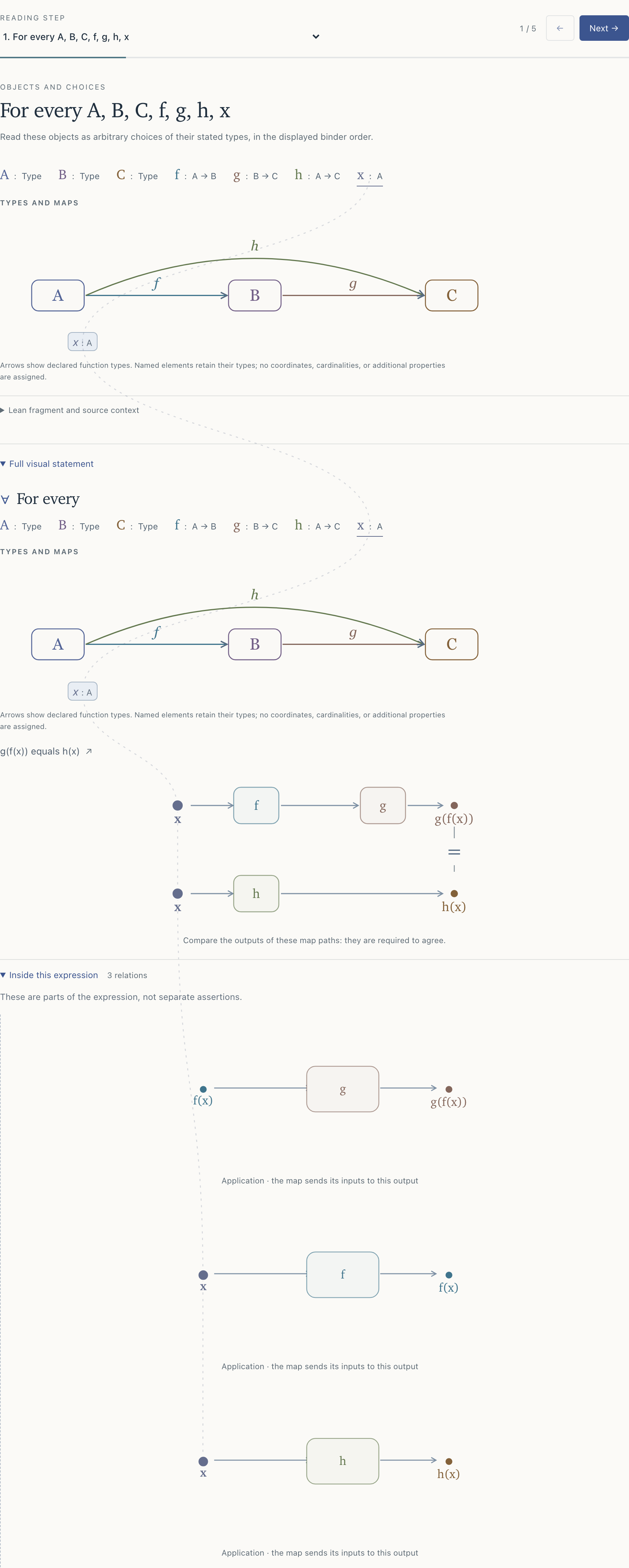
x selected, a faint dashed line joins each place where the same x appears. Captured at twice the display density. Open the screenshot on its own.The reading is at step 1. The thread joins eight appearances of x: the entry x : A in the list of variables and the small x : A box under Types and maps at this step, the same two again in the full visual statement, the start of each of the two compared routes, and the inputs of f and of h inside Inside this expression.
The thread says only that these eight are one object, the x introduced at the start of the statement. Its route means nothing.
What these views do not tell you
- That an assumption holds.
A ⊆ Bhas a card and a figure, but only as a premise. In the words of the Structure view: "A relation may occur inside an assumption, negation, or alternative; its presence is not a claim that it holds." - That the statement holds. The second statement is false (Exercise 2.3). Definograph draws it anyway, because it is a well-formed statement.
- Geometry. "These are diagrams of mathematical roles. Relative position and distance carry no geometric meaning." In the subset figure, A is not smaller than B; the two sets may be equal. The curves of the lines in the Structure view mean nothing either.
- How many elements. No figure says how many elements a set has, or that it has any.
Exercises
Exercise 2.1. In the Relationships view of the sets statement, which card is the conclusion? How can you tell without reading the Lean?
Hint
Read the tags above the objects.
Answer
Card 03. It is the only card that is not tagged as a premise. Its tags say that it depends on the premises and sits under two assumptions.
Exercise 2.2. Remove the first assumption:
∀ (A B : Set ℝ) (x : ℝ), x ∈ A → x ∈ B
Is the statement still true? Which card of the Relationships view has no counterpart now?
Answer
It is false. Take A = {0}, B = ∅ and x = 0: then x ∈ A, but x ∉ B.
The Set inclusion card has no counterpart, because the statement no longer mentions A ⊆ B. Nothing else links A to B any more.
Exercise 2.3. Is the map-path statement true?
Hint
f, g and h are arbitrary functions of the right types.
Answer
No. Take A, B and C to be ℝ, f and g the identity function, and h the constant function 0. At x = 1 the upper route gives g(f(1)) = 1 and the lower route gives h(1) = 0.
For particular f, g and h, the equation holds at every x exactly when h is the composite of f and then g. The figure shows what the statement requires; it cannot tell you whether that requirement is met.
Exercise 2.4. Trace f(x) in the Relationships view of the map-path statement. In which cards does it appear, and in which roles?
Answer
In card 03 as the output of f, and in card 02 as input 1 of g. It is one object: the result of the first application is the input of the second.
Exercise 2.5. Definograph's example Functions between arbitrary types is:
∀ (α β : Type) (f : α → β),
  Function.Injective f →
  ∀ x y : α, f x = f y → x = y
Function.Injective f says that f is injective. Which conditions are assumptions, and which one is required? If you have Definograph running, open the Relationships view of this example and compare its tags with your answer.
Answer
Function.Injective f and f x = f y are assumptions. x = y is required, under both of them.
The Relationships view has five cards. The injectivity property is a Premise of an implication. The equation f(x) = f(y) and the two applications that build f(x) and f(y) are Conditional on the premise and are themselves a premise, Under 1 assumption. The equation x = y is Conditional on the premise, Under 2 assumptions.